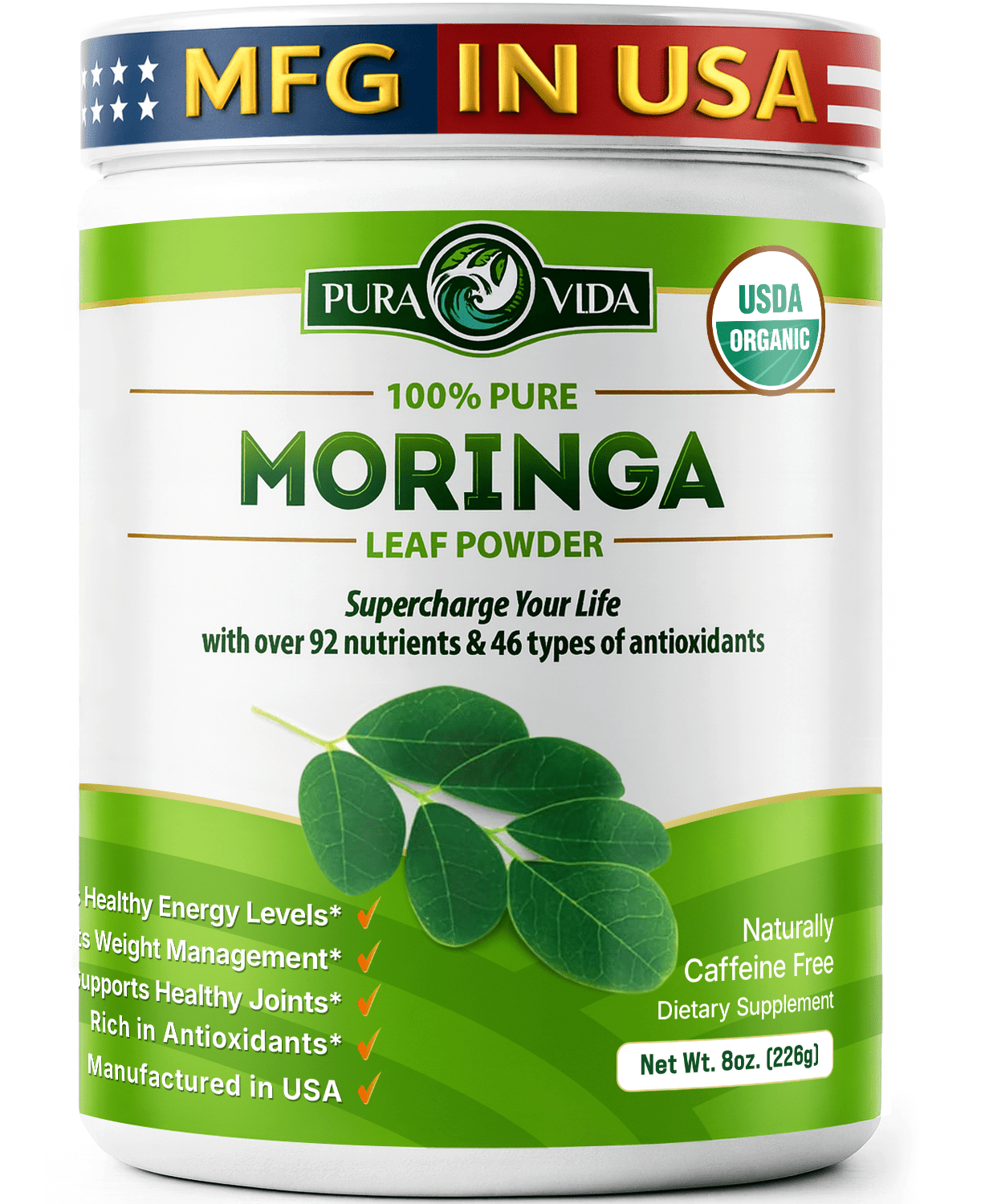
The plant behind the powder
What is moringa?
Moringa oleifera is a fast-growing, drought-tolerant tree native to the foothills of the Himalayas. Nearly every part of it is put to use. Tap a part of the tree to see what it contains and how people use it.
What is moringa?
Moringa (Moringa oleifera) is a fast-growing, drought-tolerant tree native to northern India. Its leaves, pods, seeds and flowers are all used as food.
What is moringa powder?
Moringa powder is the leaves of the moringa tree, dried and ground into a fine green powder. Nothing else needs to be added. See our moringa leaf powder
Read this section as text
- Leaves: the nutrient-dense part, about 27% protein when dried, with calcium, iron, beta-carotene, vitamin E, quercetin and chlorogenic acid. Eaten like spinach and dried into powder; the part used in supplements.
- Flowers: a nectar source for bees through much of the year in warm climates; cooked as a vegetable or steeped as tea.
- Pods: the 'drumsticks', 30 to 50 cm long, simmered in curries and soups.
- Seeds: 38 to 40% oil (ben oil, mostly oleic acid). Crushed seed clarifies cloudy water.
- Roots: a water-storing taproot that anchors soil and carries the tree through dry seasons. Not used in supplements; root bark is not recommended as food.
02 · Family
A family of thirteen
Moringa oleifera is the famous one, but it has twelve relatives, from swollen bottle trees to shrubs that live mostly underground. Pick a growth form.
Slender trees
Thin trunks and feathery crowns. This is the group people farm.
- Moringa oleiferaIndia. The one this page is about.
- Moringa concanensisPakistan, India and Bangladesh.
- Moringa peregrinaIsrael to Somalia and southern Arabia.
Bottle trees
Swollen, water-storing trunks built for long dry seasons.
- Moringa drouhardiiMadagascar.
- Moringa hildebrandtiiMadagascar.
- Moringa ovalifoliaNamibia and Angola.
- Moringa stenopetalaKenya and Ethiopia, where farmers grow it for its leaves.
Tuberous shrubs
Slim shoots above ground, a large tuber below. All four live in northeast Africa.
- Moringa borzianaNortheast Africa.
- Moringa longitubaNortheast Africa.
- Moringa pygmaeaNortheast Africa.
- Moringa rivaeNortheast Africa.
Fleshy-rooted trees
Small trees that sit on massive, fleshy roots.
- Moringa arboreaNortheast Africa.
- Moringa ruspolianaNortheast Africa.
Thirteen species in a single genus. More than half grow wild only in northeast Africa. Classification after Mark E. Olson, Instituto de Biología, UNAM.
03 · World
One tree, many names
As moringa spread from India, every kitchen gave it a name and a use. Tap a place.
Northern India
Where the story starts. Moringa is native to northern India, and its long pods go into dal and curries.
Southern India
The Tamil name. Drumstick pods simmer in sambar, and in Kerala the finely chopped leaves are cooked as thoran.
Myanmar
The pods are the star of dunt-dalun chin-yei, a sour drumstick soup.
Philippines
Leaves are dropped into brothy soups such as tinola. In the Visayas it is kalamunggay, as in the fish soup sabaw sa kalamunggay.
Indonesia and Malaysia
The Malay and Indonesian name. The leaves are a common everyday vegetable.
Red Sea and Arabia
Home of a cousin, Moringa peregrina, which ranges from Israel to Somalia. Ben oil was the perfumers' favorite of the ancient Mediterranean.
Ethiopia and Kenya
Here the family member that matters is Moringa stenopetala, a swollen-trunked species that farmers grow for its leaves.
Tanzania
The name the tree goes by in Tanzania.
Nigeria
The leaf is known as zogale. Seeds are also added to sauces or fried as a snack.
Senegal
The name is said to come from the English 'never die', a nod to how stubbornly the tree regrows. Leaf powder was tested here against malnutrition in the late 1990s.
Haiti
The name used in Haiti. Related French names include ben ailé and ben oléifère.
United States
Here it simply goes by its botanical name; 'horseradish tree' never caught on. Leaf powder and capsules have grown steadily as a supplement since the 2000s, and small family farms in California's Central Valley now grow it fresh for farmers markets and specialty grocers.
Central America
The Spanish name. Field trials in Nicaragua grew moringa as a densely planted leaf crop, cut nine times a year.
04 · History
From perfume jars to water works
Moringa has been useful for a very long time, in very different ways. Swipe through 2,400 years.
Moringa is native to northern India, where its leaves and pods have been everyday food for as long as anyone has recorded.
The Greek botanist Theophrastus ranks ben oil, pressed from moringa seed, first among oils for making perfume.
Pliny the Elder and Dioscorides both describe the tree and its fruit. Alexandria becomes the Roman world's perfume capital.
The French naturalist Jean-Baptiste Lamarck formally describes the species as Moringa oleifera.
Ben oil finds a second life lubricating clocks in Jamaica. In 1848 chemists name behenic acid after it, but by the 1870s perfumers have moved on to cheaper oils and the trade fades.
India's National Institute of Nutrition publishes its analysis of fresh moringa leaves in Nutritive Value of Indian Foods. Those tables are where the famous gram-for-gram comparisons with oranges, milk and carrots come from.
Researcher Samia Al Azharia Jahn documents how households along the Nile clear muddy river water with crushed moringa seed.
A University of Leicester team scales the idea up to a full water works at Thyolo, Malawi, cutting turbidity by about 80%.
A project in Senegal, documented by Lowell Fuglie, adds moringa leaf powder to family meals and publishes a dried-leaf analysis. The nonprofit Trees for Life turns the numbers into the comparison poster the world still quotes.
Moringa leaf, sold in the United States in small quantities since the early 1990s, begins a slow, steady climb as a supplement, spread mostly by word of mouth.
Leaf powder and capsules move from aid programs to health-food shelves. By 2013 the supplement trade press is reporting an uptick, and family farms in California's Central Valley are growing fresh moringa for local markets.
São Paulo State University researchers report that seed extract removed 98.5% of PVC microplastics from water in lab tests, on par with alum.
05 · Nutrients
Gram for gram, and spoon for spoon
Pick a food and see how dried moringa leaf compares, nutrient by nutrient. Then switch to a real serving for the practical picture.
Moringa leaf vs.
Compare
Put it to use: Moringa recipes 10 easy smoothie recipes
Read this section as text
Nutrients per 100 g. Moringa is dried leaf; the other foods are raw.
| Per 100 g | Iron (mg) | Magnesium (mg) | Vitamin B6 (mg) | Vitamin C (mg) | Calcium (mg) | Potassium (mg) | Protein (g) |
|---|---|---|---|---|---|---|---|
| Moringa leaf, dried | 28.2 | 368 | 0.61 | 17.3 | 2003 | 1324 | 27.1 |
| Spinach | 2.71 | 79 | 0.195 | 28.1 | 99 | 558 | 2.86 |
| Kale | 1.6 | 33 | 0.147 | 93.4 | 254 | 348 | 2.92 |
| Banana | 0.26 | 27 | 0.367 | 8.7 | 5 | 358 | 1.09 |
| Almonds | 3.71 | 270 | 0.137 | 0 | 269 | 733 | 21.15 |
| Pistachios | 3.92 | 121 | 1.7 | 5.6 | 105 | 1025 | 20.16 |
| Milk | 0.03 | 10 | 0.036 | 0 | 113 | 132 | 3.15 |
| Orange | 0.1 | 10 | 0.06 | 53.2 | 40 | 181 | 0.94 |
About the calcium figure: part of the calcium in moringa leaf is bound as calcium oxalate, which the body absorbs poorly, so the usable amount is lower than the 2,003 mg shown.
A 3 g teaspoon of leaf powder supplies about 0.85 mg of iron and 60 mg of calcium.
06 · Claims
The moringa claim checker
Moringa attracts big claims. We checked the famous ones against the data, including the ones that would flatter us. Tap a claim for the ruling.
0 of 8 claims checked
“Seven times the vitamin C of oranges.”
The line comes from older tables for fresh leaves, compared gram for gram. USDA data puts fresh moringa leaf at about 52 mg of vitamin C per 100 g, level with an orange at 53 mg. Drying destroys most of it, leaving leaf powder near 17 mg. For vitamin C, eat the orange.
“More iron than spinach.”
Gram for gram, dried leaf has about ten times the iron of raw spinach: 28 mg against 2.7 mg per 100 g. But a 3 g teaspoon holds about 0.85 mg, roughly what a cup of raw spinach gives you, and plant iron is absorbed less readily than iron from meat.
“It contains all nine essential amino acids.”
It does, and dried leaf is about 27% protein. A teaspoon still supplies under a gram, so it complements a meal and doesn't replace a protein source.
“It cures 300 diseases.”
No food cures 300 diseases. The figure is folklore. A 2015 scientific review found only a handful of small human studies of the leaf. Moringa is a nutritious food, and it is not a medicine.
“It absorbs 20 times more CO₂ than other plants.”
The number traces back to a 2009 book that credits data from Japan's Forestry Agency, and we could not find the underlying study. A field study in Egypt measured roughly 17 kg of CO₂ stored per tree per year, a solid figure for a small, fast-growing tree.
“Moringa seeds purify water.”
Crushed seed makes the particles in cloudy water clump and sink, removing most of the turbidity, and in 2026 lab tests it took out 98.5% of PVC microplastics. It does not disinfect. Clarified water still has to be treated before drinking.
“A 20:1 extract equals 10,000 mg of leaf.”
An extract ratio describes how much raw leaf went in. It says nothing about which nutrients came out. The 'equivalent' number is arithmetic, and it is not a measurement of what is in the capsule. The nutrient data on this page was measured on plain, whole dried leaf.
“Energy without the crash.”
Moringa leaf has no caffeine, so there is no stimulant to wear off. That also means it is not a pick-me-up: it won't act within minutes the way coffee does.
07 · Energy
Stop borrowing energy. Start creating it.
Caffeine doesn't add energy. It blocks the signal that tells you you're tired. Drag through a day to see how that plays out, then compare the nutrition route.
Follow the coffee habit over time
Illustrative model: a 5-hour caffeine half-life (individual range is roughly 1.5 to 9.5 hours), alertness that eases through the day as sleep pressure builds, and a 10 PM bedtime. With regular use the body builds tolerance, so in studies of habitual drinkers the morning cup mostly restores alertness lost to overnight withdrawal; it doesn't lift it above a non-drinker's level. Individual responses vary. Moringa is a food, not a stimulant. It adds to your daily intake of iron, magnesium and B vitamins and doesn't act within minutes.
Read this section as text
- Caffeine does not add energy. It blocks adenosine, the signal that makes you feel tired, and has a half-life of about five hours.
- With regular use the body builds tolerance. In studies of habitual drinkers, the morning cup mostly restores alertness lost to overnight withdrawal and does not lift it above a non-drinker's level.
- Coffee within about nine hours of bedtime has been shown to shorten sleep; across 24 studies caffeine cut total sleep by about 45 minutes on average.
- Moringa leaf has no caffeine. It contributes iron (oxygen transport), magnesium (needed to make and use ATP) and B vitamins (energy metabolism) to the diet, and does not act within minutes.
08 · Body
Where the leaf's compounds go to work
Choose a system to see which nutrients and plant compounds are involved, and how well each one is understood.
Read this section as text
- Energy and metabolism: iron, magnesium and B vitamins, all established nutrient roles.
- Brain and focus: iron and vitamin B6 (established); quercetin (early research).
- Gut and digestion: fiber, about one-fifth of dried leaf (established); isothiocyanates such as moringin, and polyphenols (early research).
- Skin and antioxidants: beta-carotene and vitamin E (established); quercetin, kaempferol and zeatin (early research).
- Carbohydrate metabolism: magnesium and fiber (established); chlorogenic acid (early research, with small and mixed human studies).
09 · Studies
What human studies show so far
Most moringa research has been done in test tubes and animals. These are the human studies we have read, with their limits. Filter by topic.
Antioxidant status
Leaf powder and antioxidant markers in women aged 45 to 60
- Who
- 90 postmenopausal women in India, 30 per group
- What they took
- 7 g of moringa leaf powder a day for 3 months
- What happened
- Blood levels of vitamin A (retinol) rose about 9% and vitamin C about 44%, and a marker of oxidative stress fell about 16%.
- Keep in mind
- Small groups, and the published abstract does not say whether the study was blinded.
Nutrition programs
Leaf powder added to porridge for undernourished children
- Who
- 110 children aged 6 to 59 months at a nutrition center in Burkina Faso
- What they took
- 10 g of leaf powder a day added to the center's standard porridge
- What happened
- Children given moringa gained weight faster (8.9 against 5.7 g per kg per day) and stayed an average of 36 days against 57. Hemoglobin did not improve in either group.
- Keep in mind
- A pilot study in a clinical feeding program. It says nothing about supplements for well-fed adults.
Blood sugar
A large dose of leaf powder with a meal
- Who
- 10 healthy adults, each tested with and without the powder
- What they took
- 20 g of leaf powder mixed into one meal
- What happened
- No detectable difference in post-meal blood sugar in the healthy adults. Tasters also rated the meal's color and taste lower. A second arm studied adults with diabetes, a medical context this page does not cover.
- Keep in mind
- Ten people, one meal, and a dose far above a daily teaspoon.
Safety
A review of the human research
- Who
- Five human studies of powdered whole leaf, plus animal safety studies
- What they took
- Varied by study
- What happened
- No adverse effects were reported in the human studies. The authors called the early results promising and asked for more human trials using standardized preparations.
- Keep in mind
- A review can only be as strong as the small studies it summarizes.
The short version: what is in the leaf is well measured. What it does in people has been tested only in a few small, short studies. Larger trials in healthy adults are still needed.
10 · Safety
Is it safe, and who should skip it?
Moringa leaf is an everyday food in much of the world, but a supplement isn't right for everyone. Pick what applies to you.
Healthy adult
The leaf has been well tolerated in research so far
A 2015 review of human studies using powdered whole leaf reported no adverse effects. The research is still limited, and allergic reactions are possible with any plant food. Stop and get medical help if you notice hives, swelling or trouble breathing.
Pregnant or nursing
A long food tradition, and a conversation to have first
Moringa leaf has a long history as a food for mothers. In the Philippines it is nicknamed 'mother's best friend' because the leaves are traditionally given to nursing mothers to support milk supply, and nutrition programs in West Africa have used leaf powder as an iron- and calcium-rich food during pregnancy and breastfeeding. Those are food traditions, and the controlled research behind them is still thin: it is not known how concentrated supplements affect pregnancy, or whether their compounds pass into breast milk. More studies are needed, so talk with your provider first, as always. More on pregnancy and breastfeeding
Taking medication
Check with your doctor or pharmacist
Interactions are not fully understood. Lab research suggests moringa may affect how the liver processes some drugs, and medical references single out diabetes medicines as ones to discuss before you start.
Roots, bark and seeds
Stick to the leaf
Lab studies suggest that compounds in moringa bark and root may be harmful in excess, and most safety research covers the leaf. A supplement label should tell you which part of the plant is inside.
Keep reading: Side effects and risks Gas and digestive discomfort
General information, not medical advice. Your doctor knows your situation; this page doesn't.
11 · Planet
One tree, many jobs
Moringa grows in dry, depleted soils where many crops struggle. Drag the slider to scale a planting up and see what it can provide in a year.
Estimates from published field figures. Each one assumes the planting is managed for that purpose: a tree picked for young pods won't also set seed. Real yields vary with climate, soil and care.
Read this section as text
- Carbon: about 17 kg of CO₂ stored per tree per year, from a field study of six-year-old trees in Egypt.
- Water: a tree grown for seed yields around 2,000 seeds a year, enough to clarify roughly 2,000 liters of very cloudy water. Clarified water still needs disinfecting.
- Leaf powder: about 76 g per closely planted tree per year, or about 25 teaspoons at 3 g each.
- Pods: around 400 per tree per year by the third year.
- Moringa grows on roughly 250 to 1,000 mm of rain a year, can reach 3 to 5 meters in its first growing season, and is not a nitrogen fixer.
12 · Source
Know your source
Two green powders can read the same on a label and be very different in the jar. Run the audit to see what separates them.
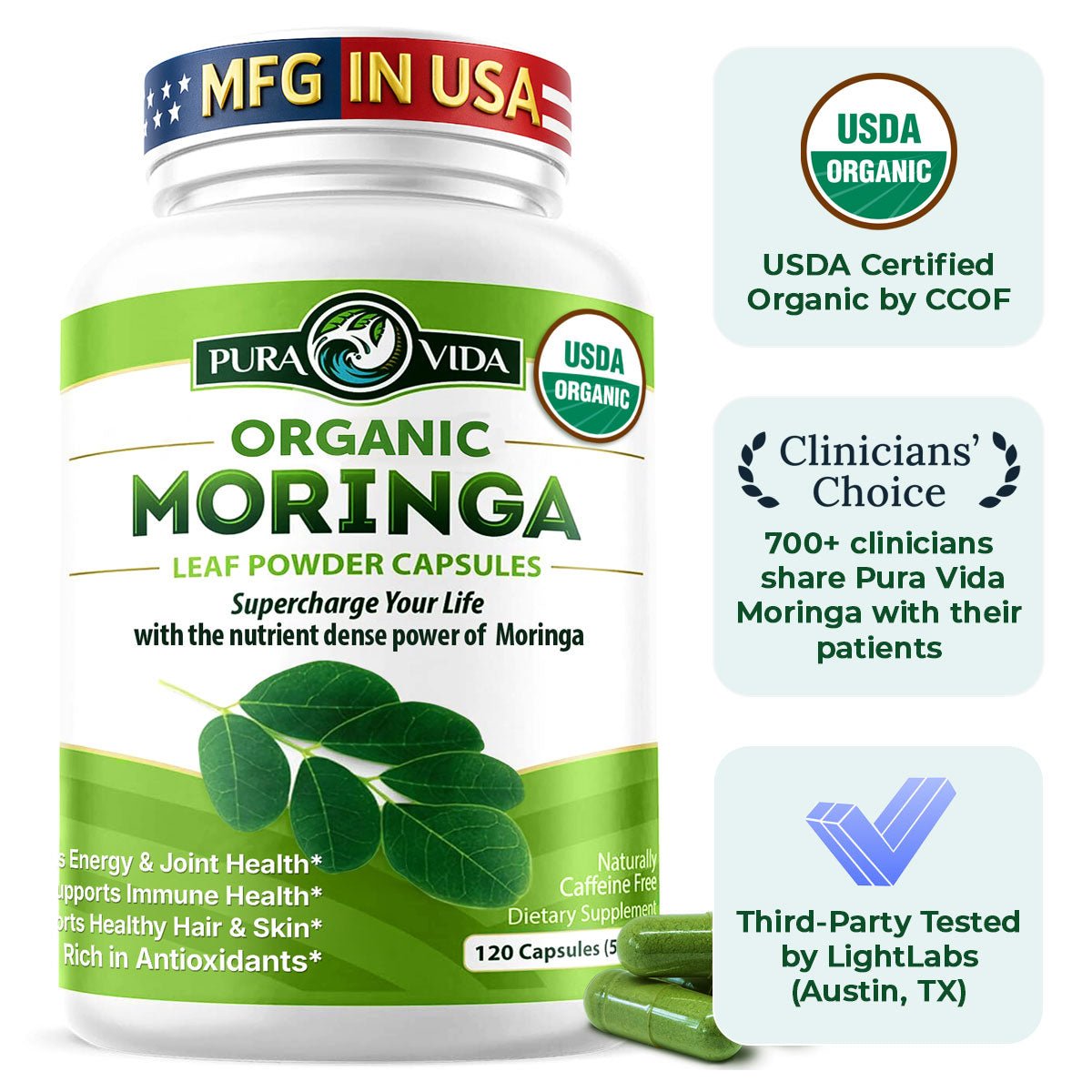
How Pura Vida does it
- USDA Organic whole leaf
- Every batch tested four times
- Final lab results published
Keep reading: How to choose high-quality moringa powder How to store moringa powder
Read this section as text
- Color: vivid leaf-green means chlorophyll is intact; olive to brown points to heat, sun or age.
- Drying: shade-dried leaves keep roughly 50 to 70% of their vitamin A, against 20 to 40% for leaves dried in direct sun.
- Heavy metals and microbes: look for every-batch testing with results you can read.
- Purity: leaf only, with no stems, fillers or flow agents.
13 · Quiz
Test what you picked up
Seven questions. Every answer is somewhere on this page.
Seven quick questions drawn from this page.
Moringa, made to fit your daily routine
USDA Organic whole-leaf moringa, tested four times per batch, with the final lab results published for you to read.
For writers and researchers
Cite or link to this guide
Pura Vida Moringa. “What Is Moringa? An Interactive Guide.” Updated November 2026. https://moringapowder.com/pages/what-is-moringa
<a href="https://moringapowder.com/pages/what-is-moringa">What Is Moringa? An Interactive Guide</a> (Pura Vida Moringa)
Using our figures
Charts, tables and numbers on this page are free to reproduce with a link back. Every module has its own link, so you can point readers at a single chart. Each figure is sourced in the notes below.
Last updated: November 2026
Sources and notes
- Food nutrient values: USDA FoodData Central (SR Legacy), per 100 g of the raw food; whole milk for milk.
- Dried moringa leaf values: Fuglie, L.J., The Miracle Tree (1999/2001), as tabulated by Trees for Life. Vitamin B6 is not in that dataset; a conservative published label value (0.6 mg per 100 g) is used. Reported values vary with soil, season and drying method.
- Daily Values: U.S. FDA, adults and children 4 years and older.
- Nutrient functions: NIH Office of Dietary Supplements fact sheets for iron, magnesium, vitamin B6, vitamin C, calcium and potassium.
- Caffeine absorption and half-life: Institute of Medicine, Caffeine for the Sustainment of Mental Task Performance (2001). Sleep pressure: Borbély's two-process model of sleep regulation. Habitual caffeine use, tolerance and alertness: Rogers, P.J. et al., Neuropsychopharmacology (2010), 379 participants; Rogers, P.J. et al., Psychopharmacology 226 (2013). Caffeine timing and sleep: Gardiner, C. et al., Sleep Medicine Reviews (2023), a meta-analysis of 24 studies.
- Carbon: Fundamental and Applied Agriculture 9(3), 2024, six-year-old Moringa oleifera in Egypt (97.6 to 111.7 kg CO₂ per tree).
- Water clarification: Lea, M., Current Protocols in Microbiology (2010); Sutherland, Folkard and Grant, University of Leicester; Feedipedia/FAO, Moringa coagulants.
- Leaf powder yield: Motis, T., ECHO Development Notes 153. Shade versus sun drying and vitamin A retention: Price, M.L., The Moringa Tree, ECHO Technical Note.
- Seed yields, pod length and rainfall range: Tropical Tree Seed Manual, USDA Forest Service (citing Jahn, 1989), and published species monographs for Moringa oleifera Lam.
- Growth rate: ECHO plant information sheet, Moringa oleifera. United States: NutraIngredients-USA (2013); UC Cooperative Extension, Fresno County small farms program.
- Species and growth forms: Olson, M.E., Moringa life forms, Instituto de Biología, UNAM. Fresh-leaf nutrient values: USDA FoodData Central (drumstick leaves, raw).
- Origin of the nutrient comparisons: Gopalan, C. et al., Nutritive Value of Indian Foods, National Institute of Nutrition, Hyderabad (1971); Fuglie, L.J., The Miracle Tree; Trees for Life, Moringa poster.
- Names and dishes: Moringa oleifera, Wikipedia (with its cited sources); Stuart, G., Philippine Medicinal Plants. Ben oil history: Ben oil, Wikipedia (Theophrastus, Pliny, Dioscorides, Burkill).
- Microplastics: São Paulo State University researchers, ACS Omega (2026), as reported by Food Safety Magazine.
- Human studies: Kushwaha et al., J. Food Sci. Technol. 51(11), 2014; Zongo et al., Food and Nutrition Sciences 4(9), 2013; Leone et al., Nutrients 10(10), 2018; Stohs and Hartman, Phytotherapy Research 29(6), 2015.
- Safety: Stohs and Hartman (2015); WebMD, Moringa monograph.
These statements have not been evaluated by the Food and Drug Administration. This product is not intended to diagnose, treat, cure, or prevent any disease.